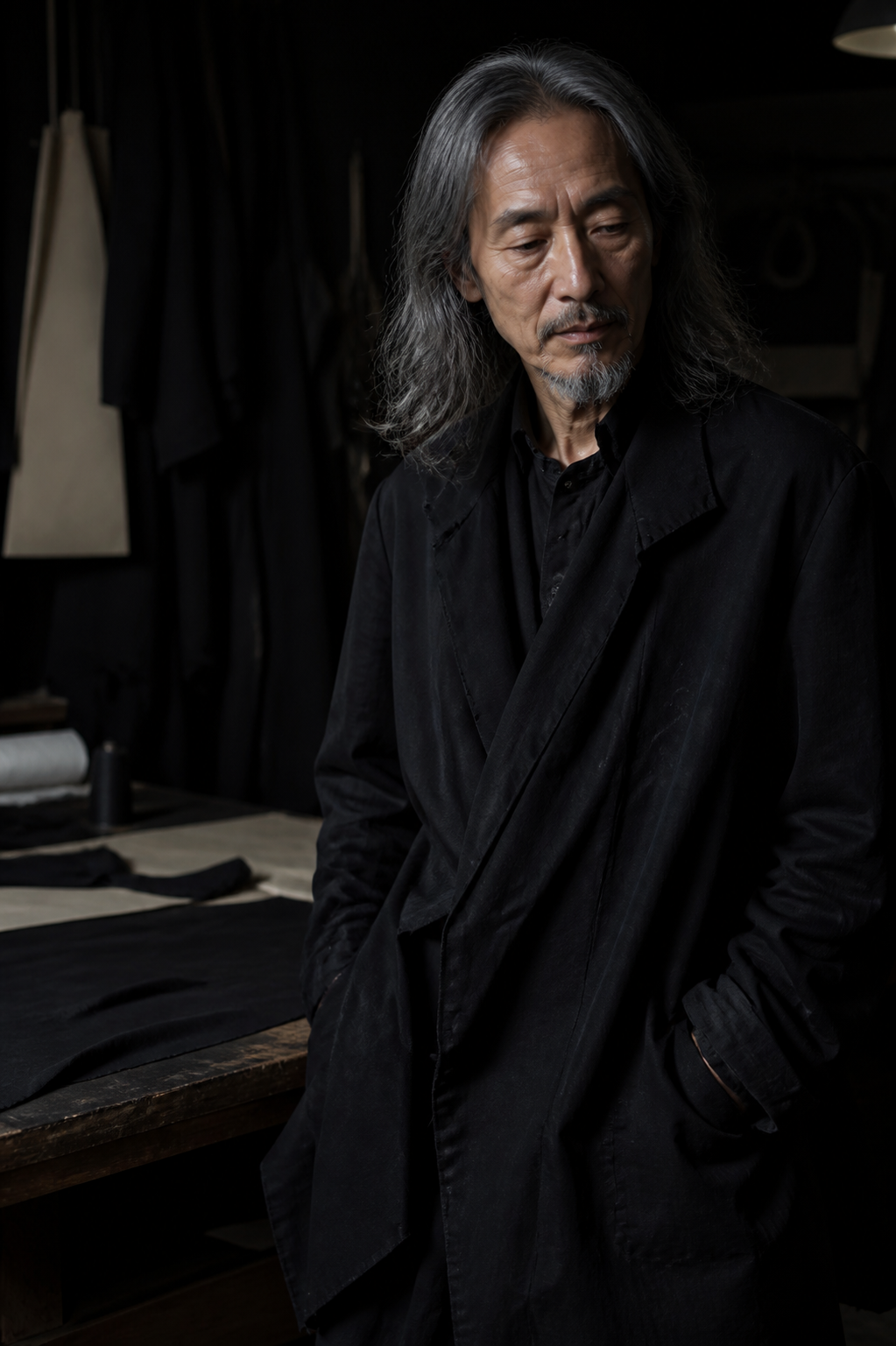
Yohji Yamamoto: Tailoring in the Shadow
Yohji Yamamoto treats black as a beginning rather than an ending. In his hands, it becomes a surface for proportion, texture and movement: a way to make the cut of a coat speak louder than its colour.
Born in Tokyo in 1943, Yamamoto established his first label, Y’s, in 1972. He presented his work in Paris for the first time in 1981, introducing silhouettes that moved against the polished, body-conscious fashion of the period. Garments appeared oversized, asymmetrical and deliberately unconcerned with conventional ideas of finish.
His tailoring is precise, but it never feels obedient. A jacket can slide away from the shoulder. A hem can fall unevenly. Fabric can gather, fold and conceal the figure instead of outlining it. The result is not a rejection of craft; it is craft used to create uncertainty.
Yamamoto’s work draws from the logic of Japanese dress, the discipline of tailoring and the expressive potential of damaged or unfinished surfaces. The V&A described his design language through the possibilities of folding, draping and manipulating textiles, as well as his ability to make black feel appropriate for every occasion.
That tension between control and collapse has become one of his defining signatures. A Yamamoto silhouette can look protective, romantic, severe or strangely weightless within the same collection. It does not ask the wearer to become a decorative object. It gives the body room to move, disappear and remain unresolved.
More than four decades after his Paris debut, the influence of Yohji Yamamoto can be felt in the modern vocabulary of oversized tailoring, gender-fluid dressing and imperfect beauty. His clothes continue to suggest that elegance is not always a matter of polish. Sometimes it is the shadow around the form.